Showing posts with label manga. Show all posts

Monday, July 26, 2010

Expo '70: Tower Of The Sun

A Journey To The Tower Of The Sun

I had a vague idea to visit the sight of the 1970 Osaka World Expo while I was in Japan last month, but not much of plan before I went. On the express train it's almost a 2 hour journey from the in-laws place, so I took with me one of my favorite manga, 20th Century Boys by Naoki Urasawa. One the advantages of a month of holidays is the time to read and wander aimlessly. I was almost to the end of the series, so it was a good opportunity to finish the last two volumes.

There were posters advertising 40th Anniversary of the 1970 Osaka World Expo at the station when I arrived at Namba. After a quick bento I studied the station map and jumped on the subway to the North of the city and the monorail which connects Senri Chuo station with Expo Commemoration Park.

In Japanese Expo '70 is known as Ōsaka Banpaku (大阪万博). The theme was "Progress and Harmony for Mankind." This was the first World's Fair held in Japan and one of the most well attended world fairs in history with almost a third of Japan's population visiting it over a 6 month period.

There are only a few remants of the expo remaining, including Tarō Okamoto's remarkable Tower of The Sun, which dominates Senri hill. As you approach from the west the tower is visible from a great distance. Okamoto was member of the Paris avant garde in the 1930's and had a deep fascination with the occult. Perhaps you can see this in the totemic style of the three external faces of the tower.


太陽の塔: The Tower Of The Sun


The Dark Side of the SunOn the front you see the present flanked by red thunder. The golden disk at the top represents the future. On the back is the black sun of the past. The interior was once open to the public, who could rise to the full heigh of 70 metres on an elevator and moving staircases. In the centre of the tower was another artwork callled the tree of life, and in the basement another face, the sun of the underworld.

The park was planned by the Japanese architect Kenzo Tange, and the structures contained within represented the peak of human engineering acheivement at the time. Highlights included early mobile phone prototypes, local area networking and maglev train technology.

Take for example the United States pavilion - extraordinary for not only the technical and architecural innovation it embodied, but for the low cost of construction - made from only four materials for less than half a million dollars. The long span cable stiffened pneumatic dome, the first of it's kind, became the model for the majority of sports domes in existence today. All that is left of the United States' pavilion is a plaque commemorating the place where it stood and the hugely popular moon rook that it housed.

The expo is situated in time between the uncertain post war years and boom years of the later part of the century. Embued with an optimism for the future, Expo '70 undoubtably had a lot to do with inspiring Japan to become the advanced technological nation it is today.

A brisk walk around the park takes two hours and is well worth it, with a wide variety of gardens and sculptures along the way. In July it was 32 degrees celcius in the shade, so not too many people were around. Though I probably wasn't allowed, I took the opportunity to cool off in a stream in the middle of a secluded forest.

Through the forest runs an elevated observation pathway, which at it's furthest end stands a massive observation tower. The tower is onstructed entirely of wood and reminded me of the traditional architecture found within Japanese castles, only without an exterior facade.

AR大阪万博
AR大阪万博 by GORIMON, on Flickr

For many people I imagine a trip to the Expo '70 commemorative park is either to remember their first visit or some retro-futurism tourist jaunt. I wasn't there for an architectural tour or nature walk however, I was there to take a trip through the world imagined by Naoki Urasawa in his epic manga 20th Century Boys. It was a bit of of a manga geek trip, manga tabi if you will.

Expo 70 was a central to the story of 20th Century boys. First in 1970 as the ruse used by a young Fukube while he was writing the book of prophecy that would herald the bloody new years eve 2000 and he coming of a global government at the end of the world.

On that bloody new years eve, Kenji scaled the robot that was bringing death and destruction to Tokyo and came face to face with the tomodachi who stood on top of a gruesome replica of the Tower of The Sun.

The Tower of The Sun featured during the last stages as the place where the tomodachi plotted the assaination of the pope. The tomodachi then staged his own resurrection in front of the masses, becoming immortal in the process.

It was place that Kanna brought the people together for one final concert before the end of the world, and where Kenji roused the people of Tokyo to revolution.

Urawasa's epic work pulls together a whole host of post modern themes, bio-terrorism, mateship and betrayal, in a coming of age story that spans three generations. To wander around the park, which is dominated by the Tower of The Sun at the centre was to put myself in the picture. When you are culturally aware, the world seems an altogether different place.

Whatever your goals are for reaching fluency in Japanese, they must be accompanied by vision and imagination. You really need to be able to see yourself doing the the things you dream. And really, the book is much better than the movie.

You might also want to read other posts on this blog about manga:
If you really want to get into to manga, but don't know where to start read my free guide to manga. It'll show you how to get over the initial hurdles of reading in Japanese.

Thanks for reading, I mean that. You are what make this blog such fabulous place to learn about Japanese language and culture. Thank you for the support and the ongoing conversation on places like Facebook and Twitter.

Saturday, July 10, 2010

Edo Period Japan Comes Alive At Okage Yokocho

Take A Step Back Into Japanese History At Okage Yokocho

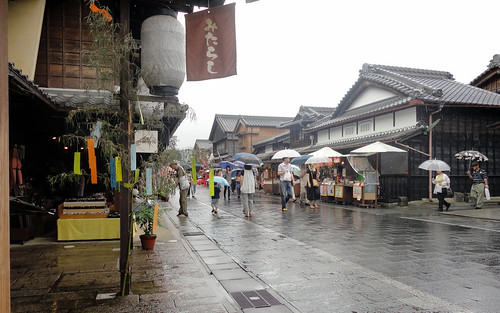
Taking a trip to Okage Yokocho (おかげ横丁|おかげよこちょう) is sometimes like stepping back in time to an Edo Period village. Okage Yokocho, is a shady side street of Oharaimachi just before you reach Naiku, the inner shrine of the Grand Shrines of Ise. In recent times it has experienced a bit of a revival. The narrow streets and restaurants are usually very crowded at new years when many people make a visit.

みたらし団子: Mitarashi Dango

Mitarashi Dango

We went in the middle of a Summer downpour on a Saturday and it was still hard to find a car park. The streets look empty here, but under every eave and doorway there were crowds of people waiting for the next break in the rain so they could make it to the next stall or performance. The store here was our second stop for Mitarashi Dango, you can see the sign just above the Tanabata decorations.

Japanese Drums

和太鼓: Japanese Traditional DrummingThe Japanese Drum (和太鼓|わだいこ) performance happens once every hour, and it always draws a big crowd. Somewhere amongst the forest of umbrellas is furious example of traditional drumming. The musicians have arms as think as tree trunks and deep burning gaze. I should have been much closer. It was enough though to stand back and enjoy the energy and enthusiasm of the performance.

Paper Play

As the large crowd dispersed there was a small gathering forming closer to the back of the main stage. There was a paper play (紙芝居|かみしばい) just about to begin so we took our seats. The performer, in yukata and geta, told the story of Shiro-kou, a dog from the Gunma prefecture.

In Edo period Japan it was quite popular for people from all over the country to make a the pilgrimage to Ise, and in the space of as little as 50 days over 3 and a half million people would arrive. Most of them on foot. Those that couldn't make it due to illness or injury would send some one in their stead to retrieve charms, some times they would send their dogs. Shiro-kou was one such dog.

The style of story telling reminded me of Rikimaru Toho, the manga reading busker from Tokyo whom I've written about before. What I didn't realise was how Rikimaru was simplying bringing a modern touch to a traditional form of entertainment.

In this new media era of television, internet and games, the paper play seems a rather archaic and simple form of entertainment. Compared with books, the history of kami shibai is still rather shallow, but story telling goes much deeper. The oral tradition is so important to the maintenance of culture. It's not just simple entertainment, but more importantly it conveys Japanese culture in a way that I'd like to see continue. You can see some of the performance in this video.

Okage Yokocho In The Summer Rain  

When you speak a second language you become part of a new socio-cultural group. What I've noticed about people who can tell a good story is that they tend to accelerate in their ability to speak Japanese. Do you have any good stories that you could tell in Japanese? You don't have to tell me right now, but when you speak Japanese you should have a story ready to go ;) I'll be here in Japan until Monday, and I'm looking forward to getting back into a routine with my blogging. I'll plan on bringing you more of my trip in future posts, including that crazy little fish shop at the end of the video. Until then Jyaa mata ne! P.S. If you like a little bit of story telling you should pick up my newsletter, you'll also get a great free guide to manga. P.P.S. If you like to keep you story telling short follow me on Twitter @rainbowhill.

Monday, May 10, 2010

Free eBook: Learn to Read Manga with Rainbowhill

Would you like to learn how to read authentic Japanese manga?


I'm happy to say that my e-book, Learn to read manga with Rainbowhill is finally finished!

And yes this e-book is totally free. It's my way of saying thank you to all the people that have come along to the edufire classes I run.

If you have never come along you can get a better idea of how much fun we have when you sign up to receive your free copy. There are some extra bonuses in there including class slides and a link to a recorded session.

When you enter your email below you'll also get a subscription to the Rainbowhill Language Lab newsletter, where you will always hear first about new live video sessions on Japanese language and culture. There are even special discounts for one to one coaching in Japanese so sign up now!


Learn to read manga with Rainbowhill
Enter your name and email below to get Free Instant Access to the most comprehensive guide available on how to start reading manga today.

In addition, you'll receive a Rainbowmail, an irreverent and irregular newsletter about Japanese language and culture filled with tips that you can't find on the blog.


Thursday, February 25, 2010

5 Top Manga Reading Techniques

Enhance your enjoyment of reading manga 5 ways.

Thank you to everyone that came to the learn to read manga session I held recently on eduFire with Natuskigirl. It was a raging success. Many thanks also to readers that contributed to the development of the class through their comments and suggestions. I realise this blog has had a bit of manga mania over the last couple of weeks, things will return to normal soon I promise.


Before things do get back to normal I'd like to share with you the top 5 tips for enhancing your enjoyment of reading manga. These tips work just as well for reading things in Japanese other than manga, so please give them a shot. Let me know how well these techniques are working for you in the comments.

Friday, February 19, 2010

Learn to Read Manga with these 5 Essential Tools

5 Essential Tools for Learning to Read Manga


When I first wrote about learning Japanese through manga in April last year I included a list of tools that I used off-line. Since then I realise that even though I read manga off-line, many of the tools I use to augment my study of manga are online. Here I'd like to expand upon that list to include the online tools as well.

Reading Manga...
Reading Manga... by hawkexpress, on Flickr

Everyone has their own preferences of course, and there are probably tools you use that I haven't mentioned. If you think there is something that should be included please comment and let me know what you would recommend. I won't talk too much about how to incorporate these tools into a study session revolving around manga. I'd prefer to keep the techniques for another post where I can go into more detail.

Monday, February 15, 2010

How to Source Authentic Japanese Manga

Where to start your manga journey


The thousand mile journey starts with a single step. Even if you are just getting into manga through scanlations and anime through fansubs, it's a start. Beware though, if you really want to experience Japanese culture you'll have to experience it first hand and one of the best ways to do that is through reading.

super happy tentacle hentai
super happy tentacle hentai by mugley, on Flickr

Let's look at some ways to source authentic Japanese manga (on dead trees) and then, while you're waiting for your shipment to come through the snow, some online manga to keep you entertained.

Sunday, February 14, 2010

Manga That Altered My Perception of Japanese Culture

4 Top Manga Titles from my Bookshelf

Last week I blogged about 7 reasons you need to get some real Japanese input through reading manga. It was really good to see comments from people with their recommendations on which titles to read and how to source them. There is so much ground to cover, so much so that I'm not going to be able to answer all your questions in a single post. I will get around to them though.

"Tomodachi" in Paris!?
"Tomodachi" in Paris!? by Mayu ;P, on Flickr

Today I want to introduce you to four manga that have not only made me a better reader, but have influenced my understanding of Japanese culture.

Saturday, February 06, 2010

7 Reasons You Need To Start Reading Manga Today

Put down that textbook now and get some real Japanese input

If you're reading this blog I think it's fair to say you are probably interested in learning Japanese. I would hope also that you want to know more about Japanese culture, because the two things really do go well together like rice and raw fish. I wonder though, how many of you are getting enough authentic input.

Tazer v.1
Tazer v.1 by KayVee.INC, on Flickr

Learning a language is all about devouring massive amounts of authentic Japanese, through books, websites, audio and video, and in conversation with people speaking Japanese. If you're not living in Japan, some of these things might be harder to do than others, but I imagine you are doing your best with what you have. That's OK, we can work with that.

Sunday, January 24, 2010

A Quick Review of the Simple Kanji Index - QuickKanji

What is QuickKanji?


QuickKanji is a simple, usable kanji index for learners of Japanese. I was immediately impressed by its speed and ease of use, especially when it comes to looking up kanji. On the downside there doesn't seem to be much community, yet it has the potential for expansion through community tools like chat, and user generated content.

A simple, usable, community based kanji dictionary

I would never have know about QuickKanji were it not for this tweet by Andrew (@l_andrew_l on Twitter), the site's creator.


There are detailed instructions about using QuickKanji on the site itself, so I won't attempt to replicate them here. Instead, let's have a look at some pros and cons.

Pros

  1. Minimalistic interface. On the home page you have all the interface elements you need to start drilling down to the kanji you want and nothing more. There is a Kanji of the Day in the info panel to get you started. There is also no need to login, no partial results, no blinding ads.

  2. Very fast for look-ups. On the top of the screen are six ways to list kanji; All, Radical, Strokes, Level, On, Kun plus Search and a cookie based Vocab List. Use any of these methods to narrow your search and select the kanji you want to bring up in the info panel.

  3. Native indexing. You won't find any old JLPT lists here to distract you from the task of discovering more kanji. Search for kanji based on radical, stroke number, educational level as defined by the Japanese Ministry of Education, on and kun readings - simple.

  4. Simple discovery of new kanji and compounds. Wherever you are, scanning the lists or drilling down into to the info area, you find opportunties to step off and investigate new kanji and related compounds.

  5. Collaborative tools. Anyone can contribute new kanji and compounds directly from the info panel. Examples sentences can be added to compounds in the list area. Any time you see a kanji compound or example sentence you can vote on that entry's usefullness. Voting affects the order of the lists in which they appear. Useless entries are eventually deleted. There is also a chat feature which allows you to chat with anyone using the site.

Cons

  1. Not very well known. I'm not sure how comfortable Andrew is with shameless self promotion but it seems his creation is lacking a little link love. I asked him how long QuickKanji had been live and was surprised to hear over a year.

  2. Very light on compounds and translations. It seems that the handful of translations that have been added have been added by Andrew himself for the purpose of demonstration. Some kanji have plenty of compounds and others none. I wonder if there is some incentive for users to create compounds and translations?

  3. Crowd sourced translation may lead to a reliability problems. Especially when the number of crowd contributions is so small, there aren't enough people to guarantee the quality of entries.

  4. QuickKanji uses only one reference coding system. And it's not even a dictionary reference! Shift_JIS is a ASCII character encoding for Japanese, handy for programmers working with Japanese but not learners. I would have liked to have seen at least one or two dictionary indices so you could at least grab a dictionary when there were no compounds or translations available. It might even encourage people to add entries and compounds.
I'll be looking more closely at how you might be able to use when learning to read Japanese through manga. How would you use it?

Thursday, April 30, 2009

How To Begin Learning Japanese With Manga

A couple of weeks ago I posted how reading manga can be good for your Japanese, but I only touched on learning to read from scratch. Thankfully, one of my friends natuskigirl (Lynn) followed through with her comment on that post, and put together two videos on how to start learning Japanese with manga. The videos are excellent in outlining the steps you need to take to start using manga as a learning aide, so I thought I might feature them here and add a few of my own ideas.

Lynn started learning Japanese from manga when she was 13 years old, and has posted lots of cool manga collecting videos on her YouTube channel "tokirocket". She knows what she is talking about, so listen carefully as she outlines a long term study plan for learning how to read Japanese with Manga.


We'll get to the second part of the video soon, but first I just want to summarise some of the points Lynn made about the first steps you need to take.


3 Steps you need to take to begin reading


First: Memorise the kana.


Japanese has three alphabets, hiragana, katakana and kanji. The kana, hiragana and katakana, both have about 50 characters, and can be rote learned in about a fortnight. This is the least interesting part of getting started, it takes commitment and effort. Once you break through however, you'll be able to pick up your first manga and start reading.

Don't worry about kanji so much at this stage, there are more than 2000 used in everyday language in Japan, so it takes years of dedication to learn them. You want to get started as quickly as possible so just concentrate on the kana. Learning the kana will allow you take advantage of furigana, a Japanese reading aide which appears above kanji in some manga. You'll also be able to recognise many loanwords from English and other languages which are normally written in katakana.


Second: Choose the right manga.


Start low, you may be an adult learner but remember your Japanese reading age is low. Steer clear of books with adult themes or highly specific language, you'll need something that matches the vocabulary you have. Doraemon, Chibi Mariko-chan and Sazae-san are titles aimed at the family market that tell stories about suburban Japanese life. Think Peanuts, and not The Dark Knight.

Although they may seem tempting at first, don't use the bilingual editions, they're a crutch. Japanese children learn to read by reading Japanese, and you once learned to read by reading English. Trust your inner child to work things out for you as you have fun with the challenge. You'll read and re-read these comics over and over again so choose something you are interested in, it will make things easier in the long run . There is no point reading about war time pilots if you have no interest in war stories.

Choose something with a long, cohesive storyline. Yonkoma, the kind of strip comics like Dilbert found in newspapers are no good because they rely heavily on puns and topical in-jokes that will be lost on the casual reader. Slightly older Manga like Sailor Moon, Hunter Hunter, and Naruto are good because they are bound in numbered volumes that have characters and a story line that develops over time.


Third: Open the book.


Manga has a few conventions that will become apparent as you flip through the pages. Are you starting from the right end of the book? The reading order is from right to left, even in most translated versions. The pages are read top down, from right to left.

Use the pictures to get an idea of the story line and the scenario, this will help you get an idea of the kind of vocabulary you'll encounter. Don't just look at the pictures though, 'read' them. The story is contained within each cell. Ask yourself these questions, in Japanese if you can. Who? What? Where? When? Why?

Your answers in Japanese will help prime you to deal with the reading. Read what you know first, if you are good with katakana, seek it out on the page and read it to yourself, out loud if you can. Katakana is often used for emphasis, as well as sound effects, think of it as the sound track to your story.

Don't worry about the slang, or words you don't know. Keep moving forward. Read each kana where and when you can.

For kanji don't be intimidated, if your manga has furigana use that, after a while you will become familiar with the most common kanji just through sheer volume. For kanji that you don't see very often or doesn't have any furigana, use a place holder word, like nantoka (something or other).

Read in small sections, stop where the scene changes. Put the book down and review vocabulary or work on your tables again. With a little rest you'll be ready to pick up the manga and start again soon. Repetition is important, don't be discouraged and just keep reading, make sure it's something you enjoy.


You'll need to have some tools by your side as you read. I'll let Lynn
explain the reading technique first and then we'll come back with some
of the tools you'll need to get started after the video.


Five tools you must have to read Manga


Reading manga is preferably something that you are going to do offline, so the tools I list here are decidedly low tech. It's good to find a nice warm spot in the sun and get away from the screen sometimes. You will need to use the internet however to source some of your material, like books and charts, also to make friends with other manga otaku.


1. Hiragana and katakana charts


Most small phrase books have these charts on the inside covers, you can also by them separately or as posters to put on your wall. If they fit in your pocket, you'll be more likely to carry them with you every where you go. You'll need to refer to them often when starting out, so have close by when you are reading.


2. A book with with basic vocabulary and grammar points


If you have bought a good phrasebook you may be able learn something about grammar, but I find nothing is ever covered in enough detail. There are plenty of good books that cover grammar structures only, but these are often very dry and technical. Even better if you can find a course book with exercises like minna no nihongo, or Japanese for Busy People.


3. English/Japanese plus Japanese/English dictionaries


Usually these two volumes come in a pair and both are important. I use Kodansha's Furigana Japanese-English and English-Japanese dictionaries, which also come as a single volume hardcover Japanese dictionary.


4. A learners kanji dictionary


It's never too early to start learning how to use one! Understanding radicals and stroke order is central to both understanding how to read kanji, and also how to find them in a dictionary like this. But it would probably take a whole series of videos to explain how this is done. Don't be intimidated by the kanji though, you need to get intimate with them.

5. A kanji study book


When you are ready to tackle Kanji, Lynn suggests you try Remembering the Kanji. I haven't read it, because I took a more native approach and used the Kanji Kentei Gakushu Suteppu (10級漢字学習ステップ) which also allowed to me to practice my writing, just as an elementary school student would in Japan.

More on learning and where to buy Manga


The focus of this post and Lynn's videos has been on reading authentic Japanese manga. There a very few places in Australia that stock Japanese books, I'm not sure about the rest of the world, but if it's anything like here you will have to hunt them down.

I would start first with friends, do you know anyone in Japan? Do have any friends travelling there soon? Make sure you ask them to pick you up a few books on your way back from Japan. Lynn raves about Ebay, and I reckon it's a pretty good place to start if you are going to buy online.

Online bookstores like Amazon, and Amazon Japan are also good. Kinokunia and Book-off are also Japanese chains, so you might a good response from them. Google Japanese book store for stores in your local area, and if your local bookstore doesn't carry any, ask them to get it in for you.

Reading manga can be good for your Japanese, make it easier for yourself by setting up with the right tools.

What manga do you read? How did you get started? Have you been doing this kind of thing online, with scanlations and online dictionaries? Let's hear about it the comments.

Wednesday, April 22, 2009

The classroom chatterer

You are encouraged to talk in class.

One of things good things about teaching at eduFire is that I learn more about teaching/learning languages than at any other time of day. It seems education is a two way street. A lot of what happens in the chat window during class is not directly related to the lesson, and it happens more quickly than I can respond to, but I'm starting to find it a valuable source of feedback about my teaching. Sometimes when I have the time, I go back through the chat transcripts just to work out what was going on.

I think you'll find it valuable as well, as students often ask me to send them the session notes and chat transcripts if they miss a class. I know sometimes they are after vocabulary, sentences and grammar points. Sometimes though it's the exchange of links that generates the most interest. So for your benefit, I'm going to give you a quick breakdown of what we talked about in class last week.

I hope to open this up to you on a more regular basis, kind of a highlight of the things we were talking about in class. Even readers of this blog who don't get into class can benefit from the things we're sharing.

Smart FM


The new Smart.FM came up in the chat and in conversation more than just about any other site, apart from maybe eduFire of course. I must have added about a dozen friends from eduFire to my friends list over there in the last few days alone. People have been raving about about BrainSpeed and I've had a few requests already for Lists (more on that later). I really need to sharpen up my repetitions on iKnow before you lot put me to shame!

Lee and Teyannie suggested some of these Japanese Lists:


Nintendo DS Emulator


I find Nintendo DS really useful for writing practice, the touch pad makes it easy to practice writing anywhere. What if you don't want to fork out for the hardware? Lee provided the single most useful link of the week, to a DS Emulator! The emulator comes zipped with Pokemon Platinum (.rar), but even more useful than that is My Japanese Coach (.rar).

Koichi posted Studying Japanese with a Nintendo DS in December last year, and the are lots of other ideas in the comments to his post. For the record I use Kanken DS (Kanji practice) and Sono Mama Rakubiki Jiken (Electronic Kanji Dictionary).


Manga


Last month I wrote about how reading Manga can be good for your Japanese, and it's a popular topic that keeps coming up in class. Everyone wants to know how to get into Manga, without having to know a lot of Kanji. There are no shortcuts to learning Kanji, it takes hours of dedication to both writing and reading. But Manga can help, especially manga with furigana. Furigana is "helper text" usually written in hiragana, so if you know how to read that it's much easier to get through a comic book without reaching for the Kanji dictionary.

If you haven't already got it, download Rikaichan, a fantastic add-on for Firefox. Rikaichan is a dictionary that reads and translates kanji for you on web pages that you visit. Of course that won't help you when you're reading hard copy. I have a few ideas that I'm working on to help you in this area. If you have any suggestions I'd like to hear about them in the comments.


Worksheets and homework


Saj made the suggestion in class that I provide some kind of homework or worksheets to accompany the lessons. Apart from the lesson notes I have on http://drop.io/rainbowhill there isn't much for students to work on outside of class.

I am currently working on compiling all of the loose lesson notes, and incorporating your suggestions in to one workbook for each class. They'll be available as a download in PDF format and will include grammar, vocab and exercises to give you a more well-rounded learning experience.

Please visit http://drop.io/rainbowhill for class notes in the meantime.


Other blogs and random links


We all love a bit of link love. These three sites came up in conversation, and are fairly representative of the kinds of blogs written by students of Japanese. Hi Chris, Kyle and Håvard!Quinsy came up with this random flash gunner game.

Watching live Japanese TV


Two live TV sites came up; Freshverse which I haven't used, but is highly recommended for anime, and the software my kids watch Japanese children's television on, Key Hole TV. If you have to immerse yourself from a distance, there is nothing better that zoning out to some Studio Ghibli.

Kansai dialect


Kansai-ben is the dialect spoken in West Japan, from Nagoya to Hyogo. Many of the best comedy acts and comedy stars come from the Kansai region, so Kansai-ben has an irreverent colloquial flavour. Michael Downey (@gakuranman on Twitter) recently posted a pub video of himself and a friend using some of the more common Kansai expressions. A while back Harvey (@JapanNewbie on Twitter) rounded up some of the more common Kansai phrases. Kansai-ben is what we speak at home, so sometimes you might hear me slip it into it.


The round-up


I hope you enjoyed that summary of what we talked about in class this week. I want to do this on a more regular basis. Watch this space for Lists on Smart.FM, workbooks for classes and more posts on using manga to improve your reading.

Sunday, March 15, 2009

How reading Manga can be good for your Japanese

How to Incorporate Authentic Reading Into Your Japanese Study

Manga has a long and colourful history in Japan, and on the back of Naruto and Death Note is becoming wildly popular in the US. In this post we look at why it's good for you, and how you can incorporate it into to your study of Japanese.

Language learning can be broken down into two parts, input and output. Input is just another way of saying the things that you read and listen to, output is what you say and what you write. Often the focus for new learners is listening and speaking, but the truth is you will never break through the language plateaus you encounter without making an effort to read and write.


Reading Japanese is easier than listening to Japanese


Learning to read Japanese may seem like insurmountable task, but it many ways it is even easier than listening. Let me explain.

When you listen to Japanese, what do you hear? If you don't have a very strong vocabulary you will hear some familiar sounds, but mostly you will hear long stretches of sound where it is impossible to know where one word ends and another begins.

Listen to the live Manga reading by Rikimaru Toho above and you'll soon see what I mean. You can find Rikumaru every Saturday night by the South entrance to Shimokitazawa station in Tokyo reading manga in character.

Rikimaru speaks very quickly, he often changes pitch, tone and speed with out warning, and there are very few pauses. Because you have this recording on YouTube you can pause, rewind and listen again, but there will still be parts that confuse you because the sounds just seem to run into each other. If you saw him perform in person I doubt he would stop to repeat himself, even if you asked him in your most polite Japanese.

Now consider what happens if you like the Manga that he reads. You decide to take it home and attempt to read it yourself. Now you have a lot more time to read each word carefully and guess elements of the story from the pictures. As long as you aren't overwhelmed by the kanji on the page, you can make out a few words that you recognise and the rest you underline so they can be looked up in a dictionary a little later.

Why you need to start reading Japanese on your own


To learn any language you need massive amounts of authentic input, and it helps if it is something that you find interesting. This is especially important if you are not living in a place where you are constantly exposed to the language you want to speak.

If the only Japanese you read is in the classes that you go to, the rate you learn new words is going to be pretty low. I make a point in my lessons on eduFire of using words that most people in the class already know. This is so we can focus on practice, without getting hung up on explanations of new vocabulary.

When you read you are going to be exposed to may more words than you would if you were just listening to a conversation. You are also going to be exposed to Japanese that is authentic and without error. Manga is almost 100% dialogue, and depending what genre of manga you read, an accurate picture of modern Japanese spoken today.

Of course if read samurai period Manga, you're going to get an authentic picture of Japanese used 400 years ago, not that you would want to use it! Better still, find something that you are interested in reading, get a few recommendations from a friend, find something that already has a translation to save you the dictionary work.


(by @yaadayaada posted with tweetshots.com)

(by @yaadayaada posted with tweetshots.com)

Where to start


A recent article in the Japan Times Online highlighted how Manga is being brought to a wider audience by "scanlators" who scan, translate and publish popular titles.

Whole subcultures have sprung up around 'scanlating' and 'fansubbing' Manga and Anime, as reported in another Japan Times Online article, helping lift J-culture over the language barrier. On the recommendation of @yaadayaada I checked out onemanga.com and found a translated copy of one of my favourite Urasawa Naoki Manga, "20th Century Boys".

Reading my Japanese copy of 二十世紀少年 (20th Century Boys) on the bus, or whenever I get a short break at work, I know that if I have any doubt about what I'm reading I can check scanlation later.

It may not seem easy at first but as Koichi said, the the secret to learning Japanese is perseverance.

I blogged a few weeks ago about using children's books, and there are plenty of online resources to help you learn Japanese elsewhere on the web. What do you use? Is reading a part of your Japanese study?

What are some good titles for people to start on? Leave your suggestions in the comments, and don't forget to follow me on twitter.