Showing posts with label youtube. Show all posts

Saturday, July 10, 2010

Edo Period Japan Comes Alive At Okage Yokocho

Take A Step Back Into Japanese History At Okage Yokocho

Taking a trip to Okage Yokocho (おかげ横丁|おかげよこちょう) is sometimes like stepping back in time to an Edo Period village. Okage Yokocho, is a shady side street of Oharaimachi just before you reach Naiku, the inner shrine of the Grand Shrines of Ise. In recent times it has experienced a bit of a revival. The narrow streets and restaurants are usually very crowded at new years when many people make a visit.
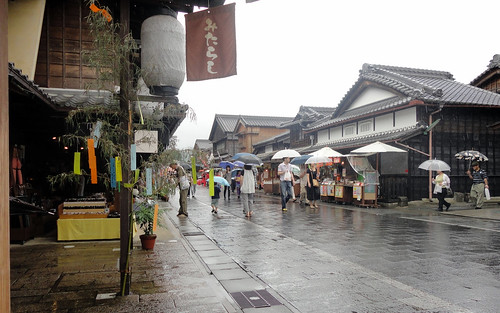
みたらし団子: Mitarashi Dango

Mitarashi Dango

We went in the middle of a Summer downpour on a Saturday and it was still hard to find a car park. The streets look empty here, but under every eave and doorway there were crowds of people waiting for the next break in the rain so they could make it to the next stall or performance. The store here was our second stop for Mitarashi Dango, you can see the sign just above the Tanabata decorations.

Japanese Drums

和太鼓: Japanese Traditional DrummingThe Japanese Drum (和太鼓|わだいこ) performance happens once every hour, and it always draws a big crowd. Somewhere amongst the forest of umbrellas is furious example of traditional drumming. The musicians have arms as think as tree trunks and deep burning gaze. I should have been much closer. It was enough though to stand back and enjoy the energy and enthusiasm of the performance.

Paper Play

As the large crowd dispersed there was a small gathering forming closer to the back of the main stage. There was a paper play (紙芝居|かみしばい) just about to begin so we took our seats. The performer, in yukata and geta, told the story of Shiro-kou, a dog from the Gunma prefecture.

In Edo period Japan it was quite popular for people from all over the country to make a the pilgrimage to Ise, and in the space of as little as 50 days over 3 and a half million people would arrive. Most of them on foot. Those that couldn't make it due to illness or injury would send some one in their stead to retrieve charms, some times they would send their dogs. Shiro-kou was one such dog.

The style of story telling reminded me of Rikimaru Toho, the manga reading busker from Tokyo whom I've written about before. What I didn't realise was how Rikimaru was simplying bringing a modern touch to a traditional form of entertainment.

In this new media era of television, internet and games, the paper play seems a rather archaic and simple form of entertainment. Compared with books, the history of kami shibai is still rather shallow, but story telling goes much deeper. The oral tradition is so important to the maintenance of culture. It's not just simple entertainment, but more importantly it conveys Japanese culture in a way that I'd like to see continue. You can see some of the performance in this video.

Okage Yokocho In The Summer Rain  

When you speak a second language you become part of a new socio-cultural group. What I've noticed about people who can tell a good story is that they tend to accelerate in their ability to speak Japanese. Do you have any good stories that you could tell in Japanese? You don't have to tell me right now, but when you speak Japanese you should have a story ready to go ;) I'll be here in Japan until Monday, and I'm looking forward to getting back into a routine with my blogging. I'll plan on bringing you more of my trip in future posts, including that crazy little fish shop at the end of the video. Until then Jyaa mata ne! P.S. If you like a little bit of story telling you should pick up my newsletter, you'll also get a great free guide to manga. P.P.S. If you like to keep you story telling short follow me on Twitter @rainbowhill.

Sunday, July 04, 2010

SHIRO Cheers System

This really made me smile today so I thought I'd share it with you. It has so many elements that I love put together in a seriously lighthearted way. You'll notice the references to the Pythagoras Switch and other low tech devices that are all about sharing the love.


From the description on YouTube;
This is a promotion movie of a Shochu, "Shiro" by Takahashi shuzo.
http://cheers-system.jp/
When we say "Cheer!", the happiness is born between two people. And it spreads to others like a chain reaction and grows bigger and bigger. We hope the Japanese Shochu "SHIRO" can bring people bit closer and happy by making them "Cheers!".
If you feel like to say "Cheers!" with friends even a little after watching this movie, we are pleasure to hear so.
My time in Japan this year is about to come to an end, so let me propose a toast, to all the things you love about Japan. May your dreams be light and fluffy!

I'll be back very soon, with some more good stuff to share!

Sunday, June 28, 2009

Weekly Links 28 June 2009

All moved into to new digs this week. A bit more of a commute to work, but more space and a small garden. Now I can start the worm farm I've always dreamed of.

Friday, June 05, 2009

7 J-bloggers far from Japan

Last month I blogged about six expats blogging from Japan, because I wanted to give you an impression of what it's like to live there. The vast majority of visitors to this blog are however are from the United States, some from Australia and Europe, so I started to wonder why people have such an interest in Japan. Sometimes it can be a passing interest in manga or anime, but other times it develops in to an full blown geek obsession with all things Japanese.

I'd like to explore where that obsession comes from, and how it drives people to create beautiful blogs and engaging content about Japan. These are people that have felt the call so hard that they've poured hundreds of hours into blogging about their passion for a place that only a few have been to, and all for you, the blog reader.

I've met most of the bloggers mentioned through Twitter, YouTube or Flickr, or just by reading and commenting on other peoples blogs. If you have a passion for Japan but don't know where to start or even why you have one, don't be afraid to speak out. We've all had that feeling! I want to hear your story in the comments, or even better, on your own blog.

Liv O.


Liv O. (ieatmypigeon) on Twitter
Name: Liv O.
Location: New York City
Web: http://www.ieatmy...
Bio: Please enjoy the daily humiliations of an American writer trying to get used to New York again after 2 years in Japan

A self deprecating humour is absolutely essential for enduring the trials and tribulations of an "adored international celebrity" in Japan, read "English Instructor". Honestly though, I thought colonials, along with the parochial use of "zed", had a monopoly on this kind of thing. Not so, it would seem. These days Liv is offering Japan-inspired tips for laundry in New York whilst getting her travel writing career off the ground. Liv was recently accepted to a Creative Writing Master’s program in Dublin, Ireland. I'm really happy for her, because her enthusiasm for writing is obvious, and she is sure to tell a good story.

Jonas


yonasu (yonasu) on Twitter

Name: yonasu
Location: Sweden
Web: http://www.yonasu...
Bio: A blogger who loves social networking and everything Japanese!

Jonas is a university student that first got in to Japan through listening to trance remixes of Hamasaki Ayumi when he was just 12 years old. He launched into blogging in lae 2007 to share his passion for Japanese entertainment. His interest in J-pop developed alongside his interest in manga and anime, and now his site yonasu.com contains a stunning array of content that has to be seen. He may have an unhealthy obsession in Kamei Eri of Hello! Project, but he isn't what you'd call "hikikomori" or socially withdrawn, he's a very social guy. Long Live Kameism!

Joe Kester


Joe Kester (JoeInJapan) on Twitter

Name: Joe Kester
Location: Maine, USA
Web: http://joeinjapan...
Bio: Former exchange student in Japan. I love studying Japanese. 日本語もOK!

Joe recently came back from Japan where he was studying at Hirosaki University as a foreign exchange student. Joe chronicled the year in video, everything from journey to Japan to the endless college parties. Now that he has settled back into things in his home town of Auburn Maine, he's focussing his attention back on study of the Japanese language. He might even be able to give you some encouragement with your study as he prepares to take the Japan Language Proficiency Test.

Sheila G.


ShiiraShiira (ShiiraShiira) on Twitter

Name: ShiiraShiira
Location: Florida
Web: http://japanesedr...
Bio: I'm just me and nobody else...

Shiira is travelling to Japan and back the easy way, with her 15 year old son in August 2009. Her blog "Gisuru" is packed with practical advice to help you prepare for a trip to Japan on a budget. Shiira fell in love with Japan in November of 2008 when she went to visit a friend who teaches English to elemenary school children. She tells the heartwarming story of how the children there gave her her name. I'm sure she'll be coming back from in a couple of months time with plenty of adventurous tales riding the rail.

Kirk Brown


Jamaipanese (Jamaipanese) on Twitter

Name: Jamaipanese
Location: Jamaica
Web: http://www.jamaip...
Bio: Jamaica + Japan

Kirk blogs about Japan with such a passion you'd think that he'd lived there for ages, but to my surprise, he plans his first trip in early 2011. Kirk is a proud Jamaican blogger who also covers positive news about Jamaica and Jamaicans. His Flickr photostream shows the kind of carefree island life most of us can only dream about. He is bringing the best of Jamaica and Japan to his readers, hence the portmanteau for his personal blog, Jamaipanese. He's an infidel gamer and an avid photographer, whose obvious enjoyment of blogging is kind of infectious.

Ryan Taylor


Ryan Taylor (c_rh) on Twitter

Name: Ryan Taylor
Web: http://www.caught...
Bio: Yorkshire lad looking to get to Japan by hook, or by crook..

Caught*Red-handed is the "wacky ramblings" of a self confessed obsessive compulsive Yorkshire lad. Ryan sure fits the bill of a passionate J-blogger. He may be wabisabi potty at the moment but he certainly isn't glossing over some of the finer points of Japanese language and culture. Just check out his series on Japanese aesthetics, he presents prose as poignantly as photography. I was really impressed by his intimate knowledge of the history and structure of the Japanese written language.

Koichi


Tofugu (tofugu) on Twitter

Name: Koichi
Location: Portland, OR
Web: http://www.tofugu...
Bio: A Wonky Japanese Culture/Language Blog

No post on J-bloggers would be complete with out a mention of Koichi, whose wonky Japanese culture blog, Tofugu, must be one most well known blogs in this little pond. I first met Koichi on YouTube when he was doing both Japanese and English posts on his Japanese channel koichiben. In the middle of 2007 he decided to separate the English blog about Japan, from the Japanese blog about America, and invite contributors Erin and Viet to form Tofugu. Koichi is one of the most sincerely generous guys in the blogosphere (if that's really a place), who always goes out of his way to help the little guy. These days he's doing the marketing for the live video learning platform where I teach Japanese.

The round up


As is always the case for a post like this, there are always people I could have mentioned, and plenty that I wanted to. Please don't feel left out if that's the case, let me know, maybe we can build our blogging relationship.

If you have an interest in Japan and you want it to develop, get involved! Join the conversation at a social bookmarking site like JapanSoc, follow us on Twitter, start commenting on some of these blogs, we'd be happy to hear from you.

Wednesday, March 11, 2009

Bad Japanese Puns

Old men tell cold jokes.

Japan is full of homophones. Wait, before you get all politically correct on me, I'll say it again - homophones - words that sound the same but have different meanings.

(by @Pirra_Jaide posted with tweetshots.com)

(by @Pirra_Jaide posted with tweetshots.com)


Bad joke? It's going to get much worse, in fact much "colder" as we take a look at some bad Japanese puns and how they can help you break through stony expressions, and hopefully crack a few smiles, on the faces of your Japanese friends.

Puns aren't just a simple way to get a few laughs, as we'll see, they can also be a great way to increase your vocabulary, word association and recall speeds. Many Japanese puns rely on kanji homophones, so knowing them, and knowing how words that sound the same can be written quite differently, is an aid to remembering the kanji. Other puns rely on katakana loanwords, and can provide an easy way for you to inject some of your own language in to the conversational mix.

First take a look at these two masters of Japanese humour, Ken Tanaka and Remi February on YouTube. See you if you can spot the gags that make ordinary people recoil in horror.


Did you get it? The first pun relies on the noun しょうが (ginger) and the expression しょうがない (can't be helped) for the punch line. If you don't have any ginger (しょうが ない?), it can't be helped (しょうがない).

The second pun relies on the similar sounding, English expression "Thank you" and the railway Hankyu (はんきゅう). There are other ways to do it, 三級 (sankyuu - Third grade) for example, but as you can see the comic effect is not lost on the station staff.

As I was preparing for Fast Track to Fluency last night, I asked some of my Twitter followers if they knew any classic Japanese puns and @losguysjapan was kind enough to share this clanger.

(by @losguysjapan posted with tweetshots.com)

(by @losguysjapan posted with tweetshots.com)


Translated as;

(by @losguysjapan posted with tweetshots.com)

(by @losguysjapan posted with tweetshots.com)


There are plenty more puns like this out there, some of which I covered with my friends on eduFire this morning. But I won't torture you with them any more, except to say this, 「お」の字をつけると、急にくさくなるところはどこだ? (What place, when you add the character "O", gets smelly very quickly?)

Answers in the comments below please! If you have any more punny (ha ha) Japanese to share, or links to humorous sites please feel free to share them in the comments below. Thanks for visiting and don't forget to add me on twitter!

Sunday, February 08, 2009

Field Mice and Japanese Mnemonics

As a language learner I'm always on the look out for new ways to learn, and I've gone through quite a few. I discard some, and devour others, but I am always hungry for more knowledge. So when I was asked by a few Australian friends to put together a crash course in Japanese for their trip to Japan I wondered how I could fit a lot of learning in a short time frame, while still keeping it fun.

ぐりとぐら1As the father of two young children I spend lots of time watching them learn and play. I have noticed that when they are having fun they are most receptive to new ideas. Every night as I read to them I know that they are soaking up knowledge, without much effort. Wouldn't it be good if all learning was like that?

For most learners it's not, and learning a second language is hard work. When you are starting out there is a lot to remember. For many people we have the benefit of time, and repetition, where techniques like spaced repetition can really work their magic.

But what if you don't have a lot of time? If you have used something like ANKI or supermemo before you'll know how quickly things get out of hand if you try to schedule too many repetitions in a short time frame.


Language learning techniques are all Greek to me


This is where a mnemonics comes into play. Mnemonics may sound like quackery, up there with hypnosis and ouija boards, but it has a long and illustrious history that started with Greek orators memorising long speeches before the senate. Now you may not need to memorise Homer's Odyssey in a hurry, but it might help to know a few key phrases before you head of to Japan in less than a fortnight.

Janie is so KoiSome people recommend using crazy visualisation with mnemonic techniques for vocabulary. It seems to me more hard work than it's worth, particularly when every thing about a new language is crazy and abstract when you are learning it for the first time. Abstraction is akin to falling in love with carp, unnecessarily complicated and unnatural.

There are several methods used in mnemonics, including the original ancient greek method of loci, and even some with a distinctly Japanese flavour. The method I'd like to focus on today is the memory peg system.


Mnemonic approaches to learning Japanese


Japanese has it's own natural "pegs" to hang memory on, called gojuuon (fifty sounds). And while you can use sentences in English like "A Kindergarten School Teacher Never Has Much Yen. Recreation WastelaNd!" to remember the dictionary order of words, wouldn't it make more sense to take a native approach?

The Japanese have been doing this since the Heian period (AD 794–1179), when the Buddhist poem "Iroha" (いろは)was written as way to order the syllabary. The Iroha is still used today as way to order seats in theatres. These days the gojūon (五十音, literally "fifty sounds") is more common as a way to order things. Conveniently enough, it's also found on Japanese cell phones (けいたい).

This means it's really easy to pick up, because it's repeated everywhere! All you have to do is hang something on those pegs that is kind of memorable, like a children’s story, and then keep building from there.

Here's something I prepared a little earlier for my class. A reading of the children's classic "Guri and Gura's A I U E O" (ぐりとぐらのあいうえお) text by Rieko Nakagawa and illustrations by Yuriko Yamawaki, published by Fukuinkan Shoten.


If you would like to learn more about this works in practice, please join me for the free class on eduFire, Field Mice and Japanese Mnemonics or ask me about it on twitter.

Do you use mnemonic devices when you study Japanese? What other memory aiding tricks have you developed?

Saturday, October 04, 2008

Learn Japanese with Brett on eduFire

There is nothing stopping you from picking up a second language right now. Millions of people all around the world are using the Internet to enhance their language skills. Live video learning is just one way of doing it.


I've recently created a profile on eduFire and I've started taking on students in English and Japanese. Ultimately I want to share with you some of the methods I have for learning a second language, because I believe any one can do it, and the Internet makes so many things possible.


Here is my introductory video for edufire, which I posted on YouTube just a couple of weeks ago. I'll be making many more basic Japanese lessons over the next couple of months and I hope that you'll tune in and just take a look. Even if you never subscribe or take a live online lesson with me I hope that you will feel my enthusiasm for languages and learning.