Thursday, June 03, 2010

Learning Japanese Through Music

How Listening To Pop Music Can Save Your Japanese

A guest post by Lauren A.

One of the most effective ways of learning a language is listening to music in the language you are studying. It is not only fun, but sets up the correct atmosphere in which language acquisition can occur. If you engage in some of the techniques outlined in this article, you will find yourself learning lots of Japanese quickly.

Pop Music Saved My Life

People that study language acquisition agree that language is best acquired in the context of meaningful, real-life situations. Since song lyrics are usually written on a single theme, and written based on the events and emotions that are experienced in real life, learning through music provides an excellent opportunity for language acquisition to occur. Songs are not a made-up dialogue in a textbook created to teach you a specific grammar point, but rather individual emotional accounts of the human condition, available in a wide range of topics.

The language found in song lyrics is the real language used in everyday life, not the stale language taken out of a textbook designed for foreigners to learn. Idiomatic and slang expressions are frequently employed, along with plain and expressive forms. Learning through songs is not your basic これはペンです (this is a pen) language learning experience. This is the kind of language learning that one can hear in real conversations. Beware of using it in formal situations!

Emotional Involvement and Active Listening


The more you like a song, the higher the chance that you will acquire the language used within the song’s lyrics. When you become emotionally involved with a song, the task of figuring out what its lyrics mean and the grammar behind it becomes an exciting quest for meaning.
  • You listen to the song again and again creating the repetitive listening “input” required for language acquisition.
  • You sing along with the song, creating the speaking “output” required for language acquisition.
  • You learn new words by figuring out their meanings based on context.
You learn new words by figuring out their meanings based on context. Because it is so fun, your brain does all the hard work without you realizing that you are actually learning. In a short time, you are remembering and using the vocabulary and grammar infused within the songs you are “studying.”

Before now, you probably already knew that learning a language through listening to music was a great method. But how can you do so in the most effective ways possible? It’s possible to passively listen to music without thinking about it and acquire a language, but this takes a very long time to reap results. To achieve the most benefit, you must actively listen to a song’s lyrics, thinking about the words as they are being used in context, and in what manner they are being used. Here are some suggested activities for actively learning Japanese through music.

Eleven Essential Activities for Learning Japanese Through Music

  1. Choose a song to study: Choosing which song to study depends on what you would like to accomplish. You can choose a song that has meaning for you, such as your favorite song, the one from your favorite show, or the one that you heard while on the train to Tokyo. You can choose a song that has a particular educational goal, such as one with a particular verb tense you would like to practice, or one based on a specific theme in which you would like to increase your vocabulary. You can choose a song based on length and/or difficulty level, such as a short and easy children’s song or a more longer and difficult ballad or rap. Ultimately, however, it really does not matter which song you choose; you will acquire language no matter which one you study.

  2. Find the lyrics to the song: Search for the lyrics online, preferably in Kanji. Choosing a song whose lyrics have already been translated will be less challenging to study than one that has no translation available.

  3. Look over the song’s lyrics: After choosing a song to study, look over the lyrics and point out all the words you already know. This serves to reinforce the vocabulary you already have acquired and helps to seal the vocabulary you have up until now only partially acquired. Listen to the song a few times and list the words you recognize from listening to the song. Say the words out loud for speaking practice. Look at the grammar being used in the song. Point out to yourself the concepts you already know well, as well as the new ones that you have not seen before, and are curious about. See if you can figure out the meanings of unknown vocabulary and grammar based on their context within the song.

  4. Study the song’s lyrics: Look up all the words that you don’t know the meanings of with a dictionary. Identify the different grammar points by performing a search in books and online. If you are using a set of lyrics with a translation, use it to see if you are using the correct definition for a word or phrase. Identify idiomatic expressions and phrases that are not translated directly from one language to the other. Create a list of the new vocabulary and grammar learned from the song for referencing and studying later on. Do this with as much of the song or as little of the song as you feel driven to do.

    Rikaichan (http://www.polarcloud.com/rikaichan/) is a pop-up dictionary plug-in for Firefox that works really well for looking up song lyrics. You can hover your mouse over the Kanji, and the program identifies the definition, the part of speech, and which form is being used along with its plain form. You can also copy and paste the definitions that you find while searching.

  5. Study the meaning of the song’s lyrics: As you are looking up the words to the song, analyze the non-literal meaning of the lyrics. Observe the way the words are ordered in each sentence and how they are being used to convey their overall meaning. If you are using a set of lyrics with a translation, use it to compare how things are being said in Japanese versus how they are said in your language. Use more than one translation of the song to verify the meanings, and if you speak another language, it is helpful to look up the lyrics’ translation in that language too. Notice the cultural differences between how each language expresses different ideas.

  6. Learn to sing along with the song: Listen to the song while looking at the lyrics, and learn to sing it out loud. Singing is a form of “shadowing,” a process whereby you acquire language quickly by repeating what a native speaker says at the same velocity. Have the vocabulary and grammar list you created available for the words you need to learn nearby to look up when you forget what something means. Listen to the song over and over, until you eventually learn to sing the song without looking at the lyrics.

  7. Sing the song again and again: Speaking output and repetition are the keys to acquiring a language, so sing along to it whenever you can. Bring the song with you on your personal music player when you travel outside of the house, and rotate it in with all of your other favorite songs. Enjoy your newfound ability to sing along with many parts of the song. Do not expect to remember the entire song the first time you sing it without the lyrics. You will need to listen to it many more times before you learn the whole song. Actively try to remember the grammar and vocabulary you studied while singing the song’s lyrics.

  8. Study more: Realize that acquiring a language is a gradual process. Some words need to be heard and recognized in different contexts many times before they are acquired. Periodically go back to your list of vocabulary and grammar from the song and look it over. Put the words you want to remember in a spaced-repetition system like Anki (http://ichi2.net/anki/) or www.smart.fm. Make new sentences with the words and grammar from the song that you still need to learn, and have them checked by a native speaker on www.lang-8.com. Use whatever study method works best for you in order to move things into your long-term memory.

  9. Study with friends: Since the goal of language is communication, studying language makes more sense when done socially. Study song lyrics together, sing karaoke together, and speak to each other using the new words. Attend classes online with others, such as the “Japanese Through Anime Music” class found at http://edufire.com/users/5219-languages-other-tutor-lauren-a, where you can learn to sing a popular Anime song together with a wonderful group of Japanese-learners.

  10. Listen for newly acquired language in other places: When hearing Japanese outside of the song you studied, such as listening to other songs, watching TV programs, or hearing native speakers’ conversations, try to actively listen as much as possible. Bring the language you are hearing to a conscious level, where you are listening to the individual words being used, recognizing and figuring out their meanings, analyzing the grammar being used, and trying to understand their meanings on a holistic level. As you do this, you will start hearing the words you learned in the lyrics of the songs you have studied prior. When hearing specific expressions, you will most likely be able to remember exactly from which song you learned it, since the brain is designed to remember things it experiences relatively and emotionally.


  11. Be creative: Realize that this article’s proposed methods are only suggestions. Be creative in coming up with your own method for studying though music and you will be learning lots of Japanese in no time!
https://secure.gravatar.com/avatar/80330f7948ccbaec1b56449dd8ec3d11?s=80&d=http%3A%2F%2Fc1.ac-images.myspacecdn.com%2Fimages01%2F20%2Fl_0ca0cf64b93416380d3364c25cab5380.jpgLauren A. is a formally trained language teacher with over two years teaching experience on eduFire. Her much loved classes, Japanese Through Anime Music : 皆さんの一番好きな音楽 are always well attended and free! Follow her on Twitter (@Vircocha1) or check out her profile on eduFire.


Do you listen to any Japanese music? Do you have any recommendations for good music to study with? I'd like to hear it! (ed)

Saturday, May 22, 2010

What Are You Anyways? Exploring Multiracial Identity With Jeff Chiba Stearns

One man's story of growing up mixed-Japanese in rural Canada.

It's funny how you can think you know a lot about a subject then all of a sudden something pops into to view that makes you look at things in a completely different way. This is just how I felt when I stumbled across the work of Jeff Chiba Stearns, a Canadian animator using his inimitable talent to explore issues of culture and identity.


His short film Yellow Sticky Notes (2007) seen here, is a reflection of this tunnel vision. When you are slave to your own productivity devices, to-do lists and buckets you become oblvious to the bigger picture. Jeff's classically animated traditional film was hand drawn with black pen on over 2300 yellow sticky notes.

Yellow Sticky Notes is winner of 11 awards including the Prix du Public Labo at the 2009 Clermont-Ferrand Short Film Festival, 2009 Best Animated Short at the Beloit and Victoria Int. Film Festivals, 2008 CAEAA for Best Animated Short Subject, Best Animated Short Film at the Calgary International Film Festival, and Golden Sheaf for Best Animation. The film also qualified for the 2009 Genie Awards under the category of Best Short Animation.

In his directors notes he gives us an insight into the painstaking process of combining fresh illustration and stream-of-conciousness with to-do lists he had compiled over 9 years of trying to get his animation career of the ground. Perhaps unwittingly during that time Jeff has also become a champion for multiracial issues, having lectured around the world on topics of identity, cultural awareness, filmmaking, and animation.

His short film What are you anyways?, winner of the 2006 ELAN for Best Animated Short Subject, expands upon the themes of growing up half Japanese, half Euro Mutt (his words) in rural Canada. As the father of two Hapa (mixed Japanese kids) I was encouraged by the sensitivity and courageous style Jeff employed in telling his story of growing up. When my kids are old enough to be conscious of their differences from other kids his film will be required viewing.

Jeff is now working on a feature length documentary called One Big Hapa Family, about children of mixed Japanese decent and the high Japanese-Canadian interracial marriage rate. On his mother's Japanese side of the family her six sisters married white men, much to his grandfather's chagrin. I expect bigs things from Jeff, and from the comments on his Facebook page I suspect so do his followers.

Do you belong to the One Big Hapa Family? How do you broach these topics of culture and and identity with your kids? Please watch some of Jeff's short films and share how you feel about them in the comments.

--

Thanks for following, I really appreciate your time here.


Tuesday, May 11, 2010

Japanese Language Coach Brett Fyfield, At Your Service

Why you should hire me as your Japanese Language Coach this Summer 


Are you looking for a Japanese course this Summer? Do you have real goals that you want to achieve with your Japanese? Do you want to make sure you are fully prepared for the JLPT well ahead of time? I'm just about to take time off from full time work for summer in Japan so this presents an unprecedented opportunity for you to accelerate your Japanese study.

"9-2-4-10-5-1" - Yokohama
"9-2-4-10-5-1" - Yokohama by Sushicam


How can I help you achieve your goals in Japanese?


I can offer you a fresh perspective on Japanese that will help you make changes which ultimately lead to more effective learning. After a few hours with me you'll have much better answers to the 'how' and the 'why' that most others take for granted. You'll be able to approach your own learning with much more flexibility and creativity.

Because the focus is on real communication with Japanese, you'll be able use the same innovative techniques to improve your ability outside of the classroom too. You'll break through those plateaus that have been holding you back from acheiving real fluency in Japanese. Before we look at the statistics you might want to know why you should learn Japanese from a non-native speaker.

Let's take a look at the statistics.


Some people like facts and figures when they're making a decision. It's not the only thing you need to think about when finding a Japanese language instructor, but helps to get some background.

In the 2 years I've been teaching Japanese, I have:
  • Completed over 60 hours of personalised one-on-one coaching in Japanese.
  • Completed over 300 hours of group sessions for Japanese students of all abilities.
  • Worked with over 65 full-fee-paying students to improve their Japanese.
  • Featured on the homepage of eduFire as a Rockstar teacher.
  • Had my class workbooks downloaded over 2000 times.
  • Been one of the "Top 5" ranked Japanese tutors on eduFire.


Don't take my word for it, hear what my students are saying.


About my Japanese Language Coaching:
Avatar_256x256_thumb_75"Brett is a great tutor who always comes up with new innovative ideas on how to teach Japanese in a fun, yet effective, way."
Philip Seyfi, New Media Designer and Developer

Björn A "Brett is an excellent teacher and he makes his lessons interesting every time. I've learned quite a bit in the few classes I have taken."
Björn A., Hopeful Exchange Student in Japan

Photo_4_thumb_75"He is flexible, engaging and expressive. He in just one lesson connected well with me and tried to understand what I wanted to accomplish. And we laughed a lot. Great tutor."
Allen Thomas, Interested in culture and communication


About my JLPT Prep Coaching:
"Good information so you can do your best on the test."
Rilitsa B.,
"Very nice teacher, and useful tips for the JLPT !"
Clear M.,
"Good tips on how to focus your study for any level of the JLPT. Lots of answers to general questions about the exam process."
Kara C., Japan Traveller

Elsewhere on the interwebs.


I've been in this J-blogger game for quite some time now, and I never tire of bringing you my unique perspective on Japanese culture. Here are some other places you can check before you make a decision.
I am offering two types of one-on-one Japanese coaching sessions.

1:1 Japanese Language Coaching


Tailored to your needs, these sessions to help you master conversational Japanese. Each session comes with a pre and post-task to help you incorporate sophisticated learning strategies into your daily study. Request a session via eduFire now or go direct with PayPal.


1:1 Japanese Language Coaching
Name
Email


1:1 JLPT Prep Coaching


I’ve spent a lot of time developing and applying the best study techniques for the Japanese Language Proficiency Test. With a highly focused 1:1 session you’ll feel more organized and confident about facing the mountain of self directed study you need to do to succeed at the JLPT, no matter what your level. Request a session via eduFire now or go direct with PayPal.


1:1 JLPT Prep Coaching
Name
Email


A Note About Booking 1:1 Sessions: Please give yourself at least 24 hours to find a suitable time. Because of the time difference between where you are and where I am in Australia, I’m probably asleep when you decide to book. Chances are if you leave it too late I’ll miss your request. I wouldn’t want to disappoint you.

All 1:1 Sessions are $60 per hour, unless you're a subscriber to my Japanese Language and Culture Newsletter. We can do them via Skype or via eduFire, whatever you are more comfortable with. Calls can be recorded on request so you can listen later.

Subscribers to my Japanese Language and Culture Newsletter get discounts on 1:1 Japanese Coaching Sessions and special insider tips on passing the JLPT.

What's holding you back from reaching your goal of fluency in Japanese?


Monday, May 10, 2010

Free eBook: Learn to Read Manga with Rainbowhill

Would you like to learn how to read authentic Japanese manga?


I'm happy to say that my e-book, Learn to read manga with Rainbowhill is finally finished!

And yes this e-book is totally free. It's my way of saying thank you to all the people that have come along to the edufire classes I run.

If you have never come along you can get a better idea of how much fun we have when you sign up to receive your free copy. There are some extra bonuses in there including class slides and a link to a recorded session.

When you enter your email below you'll also get a subscription to the Rainbowhill Language Lab newsletter, where you will always hear first about new live video sessions on Japanese language and culture. There are even special discounts for one to one coaching in Japanese so sign up now!


Learn to read manga with Rainbowhill
Enter your name and email below to get Free Instant Access to the most comprehensive guide available on how to start reading manga today.

In addition, you'll receive a Rainbowmail, an irreverent and irregular newsletter about Japanese language and culture filled with tips that you can't find on the blog.


Friday, April 30, 2010

Review: White Rabbit Press Kanji Flashcards

How to Use Kanji Flashcards to Boost Your Japanese Vocabulary

No secret, you need to have a decent vocabulary if you want to be proficient in in Japanese. Despite all the hype about the latest iPhone apps and Spaced Repetition Systems, using Kanji Flashcards is still one of the best ways to memorise large amounts of vocabulary. I'll show you how.

Mr. & Mrs. PumpMr. & Mrs. Pump by David Clow - Maryland

The systematic use of Kanji Flashcards is based on the premise that repetition of word-item pairs at regular intervals improves memory retention. Sure, Spaced Repetition Systems like smart.fm take the hard work out of organising your repetitions for you, but they shouldn't be the only tool you use.

I've recently been increasing my work-rate on smart.fm because it's fast and progress is measured, yet I still carry my White Rabbit Press Kanji Flashcards with me everywhere I go. Let me explain why.

Like most 30 something city dwellers, I carry too many gadgets. There's my cell phone, my Nintendo DS, my mp3 player sometimes an extra camera or my notebook. Leaving the house without them has a liberating effect. When I am in study-mode I can't leave the house without my kanji cards.

Kanji Flashcards help you focus on the task at hand and unlike cell phones they won't interrupt you. They work even when you are out of a mobile service area.

How to make flashcards work for you.


Having a set of flashcards isn't going to give you jedi skills automatically, you have to put the cards in to use. Here some quick tips you can use right now.
  • Be consistent: Just as with any study technique to see results you need to be consistent over time. Regular use of Kanji Flashcards should be a part of your daily routine. Your daily routine needs to include a variety of study activities, like reading for pleasure. Carry your Kanji Flashcards with you everywhere you go, and pull them out in the in-between moments you create for yourself thoughout the day.
  • Manage your repetitions systematically: Spaced Repetition Systems work so well because they use an algorithm that schedules the repetition of learned material just when you might be about to forget it. The algorithms are constantly being refined, but they were first used over a hundred years ago by obscure European scientists. You don't need to be an eccentric genius however to implement your own system. I recently described how set up my own analogue Spaced Repetition System with a Leitner box.
  • Introduce new material gradually: To avoid burnout make sure you don't put too much pressure on yourself early on. Five new items a day is a good rule of thumb, you may want to increase this to ten or twelve once you have some momentum, but any more is counter productive.
  • Use a deck that suits your learning goals: The first 900 odd cards I used came from Tuttle, and they've been good for me, to a point. Looking more closely at them now I realise perhaps they weren't the best choice for my learning goals. I'll go into more detail in a moment.

The enemies of any study routine.

  • Apathy, and laziness: No matter what study tools you have at your disposal, they all amount to nothing if you don't use them to craft yourself a new language. Get to work!
  • Disorganisation: Don't know what to do next? Constant switching between study modes could be stopping you from developing the focus and discipline you need to master Japanese. Get a plan!
  • Bad habits: Get into the habit of success. Getting into good habits takes time, and it's not something that happens the moment you decide to change your behaviour. Along with your commitment to modifying your behaviour comes a constant effort to stay on track.
  • Interruption: Learn to identify the critical and eliminate the trivial. Easier said than done, but I'm becoming a master in the art of polite refusal and cultivating the "don't mess with me, I'm studying" mask.

In a nutshell.

To make your flashcards work for you, be disciplined and use a system for organising your repetitions. Carry them everywhere you go. Gradually increase the rate at which you are introducing new material.

How do the White Rabbit Press cards stack up against the others?

As I mentioned before I've known two sets of cards. My first two boxes were Tuttle Kanji Cards. Now I carry both and I'm happy to endorse White Rabbit Press Kanji Flashcards over Tuttle for a whole number of reasons.

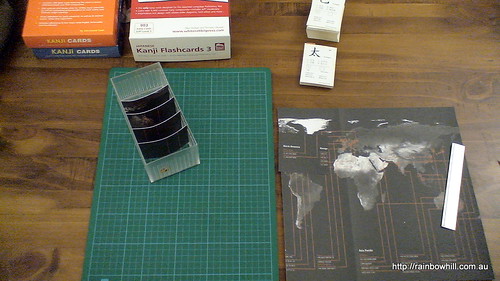
The presentation and finish of the WRP Kanji Flashcards is excellent. The cards won't go yellow as quickly because of their varnished surface. This, and the rounded corners make it easier to hold them and flip between them. At first I was clumsy with them because of the landscape orientation but I'm steadily becoming accustomed to them.


Each card has six word/phrase items compared to the four on the Tuttle cards. Each item is complete as an example of usage, rather than an abstract pattern. The front of the cards have fewer distractions on them, as there are no references to common dictionaries or kanji grade on the front of the card. The are examples of look alike kanji, something that is important if you are studying for a test that contains lots of multiple choice questions with similar looking kanji (hint hint).

If you are studying Japanese over at textfugu, then you'll know how much of an emphasis Koichi puts on learning radicals. The White Rabbit Press Kanji Flash Cards clearly identify the radical on the face of the card. The focus is clearly on the structure and use of the kanji, not the clutter.

On the back of the cards each kun and on reading is written in kana, all the Japanese is in Japanese, which makes a lot more sense. Everyone knows that romaji is a crutch. This is by far and away the most important point for me in preparation for the JLPT this year. Reading Japanese on the front and the back of the card means that I don't have to make the cognitive leap from Japanese to English and and back again each time I flip the cards over. For this point alone you should buy the WRP Kanji Flashcards.

There are other benefits to these cards, including the extensive support and documentation available at the White Rabbit Press site.

Visit White Rabbit Press to get more to get more details, including information about which cards you'll need for the New JLPT.

My disclosure and a confession to make.

Joseph Tame from White Rabbit Press generously offered me Volume 3 of the Kanji Flashcards to test drive in January. I would have paid for them but they came just at the right time as I was at the point of making a decision to continue with the Tuttle cards I'd been using up until then. I'm glad I made the switch.

Joseph interviewed me a while ago on the Japan Podshow, long before he became involved with White Rabbit Press.

The biggest confession I have to make is that I've been sitting on these for so long. First, I wanted to consolidate my knowledge of the first 1000 kanji, which I did with the Tuttle Cards. Second, I didn't feel I could endorse them as well as I do know with out using them consistently for a few months. I've been meaning to review them for ages.

You'll notice that I'm rather particular about the things that I recommend on my blog, now just seems to be like the right time. I don't have the first two boxes, though I probably should put in an order just to round out my set.

Do you use Kanji Flashcards? Which ones? Do they work for you?

Thanks for making this blog such great place to learn about Japanese language and culture. Thank you for the 'like' on Facebook.

If you want to find out more about the cards from people that are using them check out the White Rabbit Press fan page on Facebook. They are also on Twitter too (@WhiteRabbitJpn).


White Rabbit Press Kanji Flashcards

Monday, April 12, 2010

Pros and Cons of Using a Japanese Electronic Dictionary

Are you still lugging dead tree bilingual dictionaries?

Nintendo DS Kanji Sonomama Rakubiki Jiten Jedi Skills for Japanese
I'm trying to carry less.

I used to think using a traditional paper dictionary had a lot more going for it than an electronic dictionary. I'm now starting to believe that electronic dictionaries may be more useful. There are still a lot of pitfalls if you are just starting to learn Japanese, so I'd like to outline some pros and cons to help you decide what might be best for you.

Saturday, April 10, 2010

How To Avoid Burnout Learning Japanese

Learning Japanese: Taking on Too Much Too Soon?

We've all been there before, some crazy idea pops into your head about living and working in Tokyo for a year or following the cherry blossom front from Okinawa to Hokkaido. A love affair with all things Japanese fills your head with ideas of romance under sakura in the the Land of the Rising Sun (and other cliche). The next thing you know you've clicked through some crazy adsense promising immediate language gains and before you know it spent a fortune on language CD's, books and lessons.

Maiko
Maiko by FLEECIRCUS

Because you're highly motivated you throw yourself into your new found passion only to find that results aren't coming as quickly as you'd hoped. Now you've wasted all your hard earned cash on books that are gathering dust and your dreams of fluency in Japanese are fading fast. Burnout.

Buying more textbooks isn't going to help you out of this pickle, nor are more lessons, you probably still have a book full of tickets left anyway. It feels bad, doesn't it? But wait, there is a way out, so don't give up just yet.

Sunday, April 04, 2010

From Uninspired Images to Dream Fluency

April 5th Link Post - iPad my bag so Easter eggs don't break

From uninspiring images to dream fluency this week has really had its up and downs. This month has too, but I'm going to avoid any biblical references, and just mention that anonymous says hello.

Two really ingenious design related things from Japan I noticed in my feeds this week. The first is an office waste paper recycling plant that turns your TPS Reports into toilet paper. Don't forget to add the cover sheet. The second is a floor mat that adapts to you as lounge about on the floor. The design makes a lot of sense when you consider that most of the action in a Japanese house happens on the floor.

The bitter*girls bring us tilt-shift sumo, the Japanese tradition (Hat tip to pinktentacle). The bitter*girls also had a dream, Fireworks like Rorschach inkblot tests. We all have a theory, and it's good to share your thoughts.

One of my favorite J-bloggers recently appeared on Twitter, Mari Kanazawa (follow @watashi_tokyo) she's the real deal. I'd like these weekly posts to be as eclectic and curious as Mari's are, I doubt I could post with such consistency however.

To get an idea of how I roll when blogging here is my version of floor culture. It's either seated, standing or rocking, but rarely a chair in sight.

Thanks for following, I mean that.

Join in the conversation on the Rainbowhill Facebook Page, or follow me on Twitter, it's kind of like an AA meeting for internet junkies.

I leave you with footage of a guy smashing his iPad to pieces for a slice of internet notoriety.

Friday, April 02, 2010

Speaking Fluent Japanese: In Your Dreams

Sleep Your Way to Speaking Fluent Japanese.

Have you heard that blogging is a form of self-help therapy?

Let me lay myself out on the counselling couch and tell you a story.

It all relates to one of my first dreams in Japanese. One that I have only told to few people. I've done enough analysis of it on my own, but it still puzzles me as I have no formal training in Psychology or dream interpretation. All I can offer you is an observation of a very peculiar experience.

224/365「Ka」は刀(かたな)です (Katana) by Kanpeki Yume (Perfect Dream)
224/365「Ka」は刀(かたな)です (Katana) by Kanpeki Yume

It must have been at the end of my first year in Japan. I had been immersed in the Japanese language, hearing it spoken each day and attempting to speak it to whoever would listen. I was a faltering and hesitant speaker.

My work as an English teacher was stimulating and challenging enough. At the end of each day, after a late supper and a couple of beers I would fall in to a restless sleep. My body was always racked but my mind was active.

Sunday, March 07, 2010

OK, Go! Do The Pythagoras Switch

Were OK, Go! inspired by the Japanese Pythagoras Switch?

I thought I was watching Japanese comedy duo Pythagoras Switch when first I saw the Rube Goldberg version of 'This too Shall Pass' from Illinois band OK, Go!


Pythagoras Switch [ピタゴラスイッチ | Pitagora Suicchi] are probably more famous for their Algorithm March, which has been copied all over the world from hitchikers in Europe to prisoners in the Philipines. Sure it's entirely possible, these guys do it over and over again for NHK. Can you see any similarities?

Saturday, March 06, 2010

Learn Kanji with an Analogue Spaced Repetition System

Crush your kanji with a Leitner learning box

Earlier this year I set myself the challenge to review the 2000 jōyō kanji by December when I plan to re-sit the Japanese Language Proficiency Test. The problem that I face daily is how to manage my flashcards efficiently so that kanji I know well moves back into the box. Ideally I don't want to carry cards that I know well so I can increase my kanji learning rate.

I was recently given a set of Kanji Flashcards from White Rabbit Press to review, but before I do I want to put them to good use. I already own a set of Tuttle Kanji Cards so it seems like a perfect opportunity to do a comparison as I work my way through the jōyō kanji. I'm using a learning technique called spaced repetition that incorporates increasing intervals between the review of each known kanji.

Leitner Box Preparation - Four
Leitner Box Preparation - Four by Rainbowhill LL, on Flickr


Monday, March 01, 2010

Japanese iPhone Apps and Black Ships to Mixi

March 1st Link Post - Ureshii Hina Matsuri


As mentioned two weeks ago, posting about iPhone apps is a sure way to get hits. It looks like Yonasu is on to a good thing here with 5 Japan-related apps for your iPhone. Once again anything that contains the three keywords iPhone, Japanese and Twitter gets hits big time.

Lee from Tokyo Times asks is it wabi-sabi or just way-off? Tough question, but just like horse-radish it is a an acquired taste. No, that's wasabi!

While you were all learning how to read Japanese manga, Nick Simmons (son of rock legend Gene Simmons) was learning how to draw it. Too bad he didn't give up the tracing habit before he took someone elses work to the publisher and passed it off as his own. Shame on you Nick. You can see for yourself the blatant theivery here.

OrigamiPod : icPod for everyoneI'm all about finding new study techniques for Japanese, so I was interested to see just how many people clicked on the Leitner flashcard system link from wikipedia. It's just like an SRS but for your bookshelf. If you are interested in kanji flashcards of the paper variety watch this space, I'll be featuring cards from White Rabbit Press and the techniques you need to use them here on this blog in the next couple of weeks.

In the meantime you may want to find out how to get into mixi without a Japanese cellphone from Tofugu, I hear there is a also a giveaway for flashcards if you check out the video.

If you want more linked up goodness, make sure you follow me (@rainbowhill) on Twitter. The links alone are all available as a feed on bit.ly.

Thanks for reading, I mean that!

Image: OrigamiPod : icPod for everyone by hawkexpress, on Flickr

Thursday, February 25, 2010

5 Top Manga Reading Techniques

Enhance your enjoyment of reading manga 5 ways.

Thank you to everyone that came to the learn to read manga session I held recently on eduFire with Natuskigirl. It was a raging success. Many thanks also to readers that contributed to the development of the class through their comments and suggestions. I realise this blog has had a bit of manga mania over the last couple of weeks, things will return to normal soon I promise.


Before things do get back to normal I'd like to share with you the top 5 tips for enhancing your enjoyment of reading manga. These tips work just as well for reading things in Japanese other than manga, so please give them a shot. Let me know how well these techniques are working for you in the comments.

Friday, February 19, 2010

Learn to Read Manga with these 5 Essential Tools

5 Essential Tools for Learning to Read Manga


When I first wrote about learning Japanese through manga in April last year I included a list of tools that I used off-line. Since then I realise that even though I read manga off-line, many of the tools I use to augment my study of manga are online. Here I'd like to expand upon that list to include the online tools as well.

Reading Manga...
Reading Manga... by hawkexpress, on Flickr

Everyone has their own preferences of course, and there are probably tools you use that I haven't mentioned. If you think there is something that should be included please comment and let me know what you would recommend. I won't talk too much about how to incorporate these tools into a study session revolving around manga. I'd prefer to keep the techniques for another post where I can go into more detail.

Monday, February 15, 2010

How to Source Authentic Japanese Manga

Where to start your manga journey


The thousand mile journey starts with a single step. Even if you are just getting into manga through scanlations and anime through fansubs, it's a start. Beware though, if you really want to experience Japanese culture you'll have to experience it first hand and one of the best ways to do that is through reading.

super happy tentacle hentai
super happy tentacle hentai by mugley, on Flickr

Let's look at some ways to source authentic Japanese manga (on dead trees) and then, while you're waiting for your shipment to come through the snow, some online manga to keep you entertained.

Urban Myths to Reverse Chocolate Valentines

February 14th Link Post - Happy Valentines Day!

There must be something in the water that J-bloggers are drinking this week, and it's not Eromanga. Pink Tentacle offers up another Japanese urban myth that the small South Pacific island of Eromanga (Iromanga?) has sunk beneath the waves. While you and I both know Eromanga is a small town in South West Queensland, in fact the furthest town from any ocean.

One for all the music lovers, Yonasu shows us how to use the Japanese interface of iTunes, opening up functionality not normally seen in the US version. I'm not an iTunes user myself, but every time I mention iPhone apps for Japanese on Twitter my bit.ly clicks go off the dial.

Kirk used his blog Jamaipanese to promote efforts to raise relief funds for Haiti through a moving music video "Rise Again". Kirk has donated money and a couple cases of water through the office where he works, good on you mate. Make sure you chip in this year to help make his savings targets for Operation Visit Japan.

Define expat. Define successful. Alex raises all sorts of interesting questions about what it means to be non-Japanese in Japan with his list of top 10 successful expats in Japan. At least it does show the changing face of Japan. To put a slight twist on it Curzon on the Mutant Frog Travelogue shows us some white faces with Japanese names. I'm not confused, I'm an Australian who speaks Japanese at home, in Oz.

Happy Valentines Day, I was looking forward to a home baked chocolate cake but my son likes apples so I got trumped. All's good though, there was absolutely no mention of reverse chocolate.


Thanks for following, I mean that!

Become a fan on Facebook, or sign up for the Rainbowhill Language Lab Newsletter for exclusive content. Are you buzzing yet?

Sunday, February 14, 2010

Manga That Altered My Perception of Japanese Culture

4 Top Manga Titles from my Bookshelf

Last week I blogged about 7 reasons you need to get some real Japanese input through reading manga. It was really good to see comments from people with their recommendations on which titles to read and how to source them. There is so much ground to cover, so much so that I'm not going to be able to answer all your questions in a single post. I will get around to them though.

"Tomodachi" in Paris!?
"Tomodachi" in Paris!? by Mayu ;P, on Flickr

Today I want to introduce you to four manga that have not only made me a better reader, but have influenced my understanding of Japanese culture.

Sunday, February 07, 2010

From Friendly Demons to Eromanga in South West Queensland

Sunday, February 7th Link Post

It might  have been fitting for the week of the Japanese festival setsubun that j-bloggers explored the demonisation of foreign populations. Deas posted a photo of a protest placard denouncing unwelcome American bases in Guam, Okinawa and Japan. It seems people have short memories. Japan was a brutal occupying force in Guam, not to mention Manchuria and the Korean Peninsula.

Japanese xenophobic policies persist even today, with Japanese born children of foriegn-born parents being expelled from the country. In an excellent guest post on LoneleePlanet Scott Jeppesen explored a time when the shoe was on the other foot for Japanese in Peru. Perhaps we should be welcoming our demons in!

On this blog I released the slides from my most recent eduFire class on how to ace the JLPT, while people were celebrating (or comisserating) their 2009 results on Twitter. Now it's time to get your read on, and learn how to put the fun back into your study. Self paced learning is the way to go, over the next few months you'll hear lots from me on putting your social network to work for you. Meanwhile pick up a few tips about quality items for your SRS from Liz.

The demon really is outside, and he’s huge!
jrfiction:

[塩谷郡藤原町藤原]鬼じゃー!
via onosendai.jp
You ought to be thinking about quality learning techniques, because as this post shows, you can never rely on machine translations. As they say, the only constant is change, what you learn today might be out of fashion in 10 or 20 years so please don't stop learning. It really would be tough to be dumped from your job in eikaiwa and forced to live in a blue tent, but maybe it's just that kind of immersion you really need to accelerate your Japanese.

At least you can read about it, and I'll be exploring these themes in the lead up to my learn to read manga class on edufire with natsukigirl. Don't get the wrong idea about eromanga though, Eromanga is really a town in South West Queensland. Follow me on twitter. Who knows, I may be able to trade my twitter follower count in for a discount on ramen next time I'm in Japan.

Thanks for following, I mean that!

Become a fan on Facebook, or sign up for the Rainbowhill Language Lab Newsletter for exclusive content.

Saturday, February 06, 2010

7 Reasons You Need To Start Reading Manga Today

Put down that textbook now and get some real Japanese input

If you're reading this blog I think it's fair to say you are probably interested in learning Japanese. I would hope also that you want to know more about Japanese culture, because the two things really do go well together like rice and raw fish. I wonder though, how many of you are getting enough authentic input.

Tazer v.1
Tazer v.1 by KayVee.INC, on Flickr

Learning a language is all about devouring massive amounts of authentic Japanese, through books, websites, audio and video, and in conversation with people speaking Japanese. If you're not living in Japan, some of these things might be harder to do than others, but I imagine you are doing your best with what you have. That's OK, we can work with that.

Tuesday, February 02, 2010

Your Guide to The Ultimate Setsubun Party

Scattering Beans and Eating Ehomaki to See in Spring

The Japanese Festival of Setsubun celebrates the coming of spring. Each year about the 3rd or4th of February people gather to ward off evil spirits and invite good fortune into their lives. Like most festivals in Japan there is a fair amount of superstition and some ritual involved, but it's all good clean fun, especially for kids.

Day 034 / 七福恵方巻き食べた。 February 03 by [puamelia].
七福恵方巻き食べた。 by [puamelia]. 

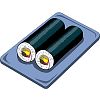
The tradition of eating specially prepared rolled sushi (恵方まき | ehomaki) while facing in the new years lucky direction originated in Kansai. This year the direction to face is a little to the right of West, So'West. (2010年の恵方は「西南西」). It is customary to eat the whole roll in one go while making a wish.

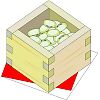
The special ritual to ward off evil spirits is called mamemaki (豆まき | bean scattering) and is usually done by the toshiotoko (年男 | senior male) or the male who was born in the current chinese calendar year. Beans are thrown in the direction of a less fortunate member of the family wearing a demon mask.

Follow a few of these simple steps and you could have Setsubun party to remember for your household or your neighbourhood.

Preparing your bean scattering party


Make a demon mask: Oni-no-men (鬼の面 | Demon mask) are easy enough to make out of paper or card. If you're the creative type you can get a few good ideas from a Google image search for 鬼の面. You can you print out this paper craft oni-no-men on the Kids goo site to colour in later, or save time by doing it online. There's even a full craft set for setsubun with instructions. I'm going for a slightly scarier mask from Yamaha paper craft for all seasons.


Prepare ehomaki: Preparing sushi needn't be just for the foodies, and rolling it yourself always brings satisfaction, for me anyway. There are stores that prepare special once a year ehomaki, for which people queue for hours before dawn, but you don't need to go to any extremes. If you're game try this ehomaki recipe from cookpad, Japan's most popular recipe site. Or for a comprehensive look at tips and techniques for making maki sushi at home visit the Sushi Faq.

Throwing the party, eating sushi and scattering beans to see in Spring


Decide who your demon is going to be before things get underway, the element of surprise is most important if you're going to have the most fun. The party begins with the customary scoffing of the ehomaki. Stand facing a little to the right of West So'West, this year's lucky direction, to eat your sushi while making a wish. Make a big wish because it could take a while, it's important to finish the whole roll without stopping.

During the rest of your meal, which might be something as simple as sardines on rice, count enough roast soybeans for each year of your age plus one for good luck. The surplus beans are gathered up and placed in ceremonial cups (paper will do) in preparation for scattering. As you eat your beans take time out for reflection. Once you're done pick up your paper cups and head towards a door or open window to begin the bean scattering ceremony.

It is usually at this time that the demon appears and the chant rises up to cast out evil and bring in luck. Toss your beans at the demon while chanting "Oni wa soto, Fuku wa Uchi!" (鬼は外! 福は内! | Out with the Devil! In with good fortune!). In the Fukushima region family members yell "Oni no medama buttsubuse!" (鬼の目玉ぶっつぶせっ! | Demon's eyes, crush crush!). You may want to choose your own local version too!

Have you experienced Setsubun before? Do you plan to do anything this year? Post some photos of your favourite demon mask on the Rainbowhill Facebook Fan Page and join in the conversation.

Setsubun images courtesy of http://illpop.com/